Wine customs data · 20 detailed markets

The global wine trade,
decoded.

Who buys your wine. And your competitors'.

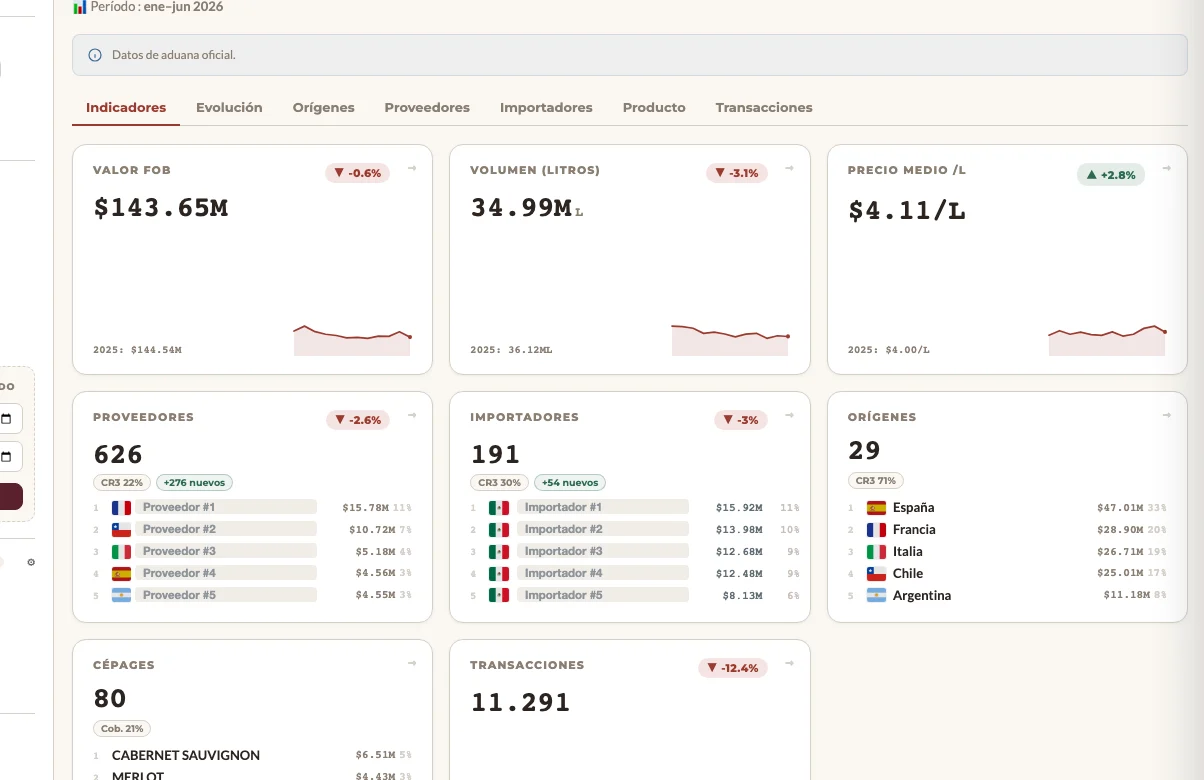
20 detailed markets — import (USA, Brazil, Mexico, Argentina, Russia, Peru, Vietnam, India and more) + Argentina and Chile in export. 18,500+ verified importers and exporters, with their real flows: brand, price, volume, buyer.

20 markets · 18,500+ companies · brand, price, buyer.

Explore
Built for the whole wine ecosystem

One platform, three use cases

Wineries that export, importers analyzing competitors, consultants who need citable data.

🍇

Wineries exporting wine

Identify your next importers. Know who buys your style, in which markets, at what price — and who your competitors already sell to.

  • 5,800+ verified wine importers across the 16 markets
  • Each importer with their actual suppliers and purchase volumes
  • Real competitor positioning: brand by brand, price by price
  • Direct buyer contacts (premium plans)
Identify my importers
🚢

Importers and distributors

Analyze your competition. Who sells what, to whom, at what price. And for every exporter in the world: their actual customer book.

  • 10,300+ exporters and suppliers with their customer book
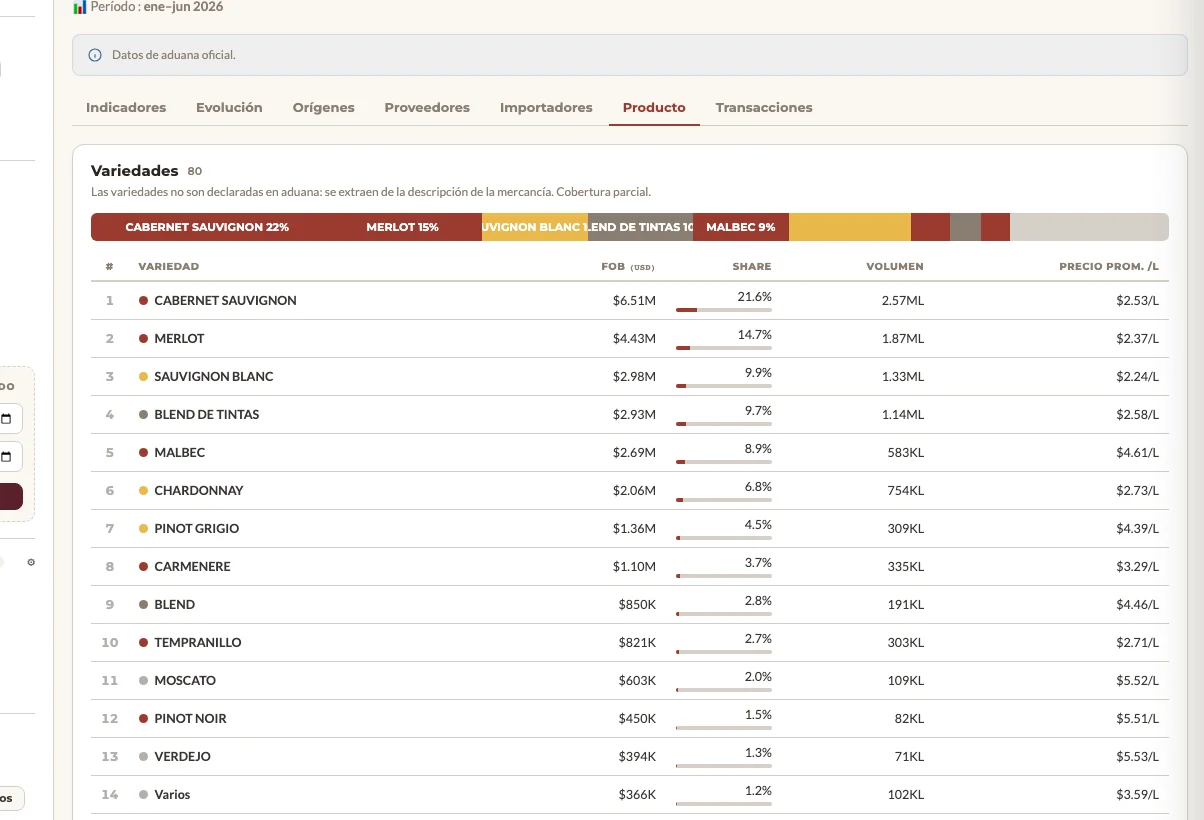
  • Customs data brand by brand: price, volume, grape, format
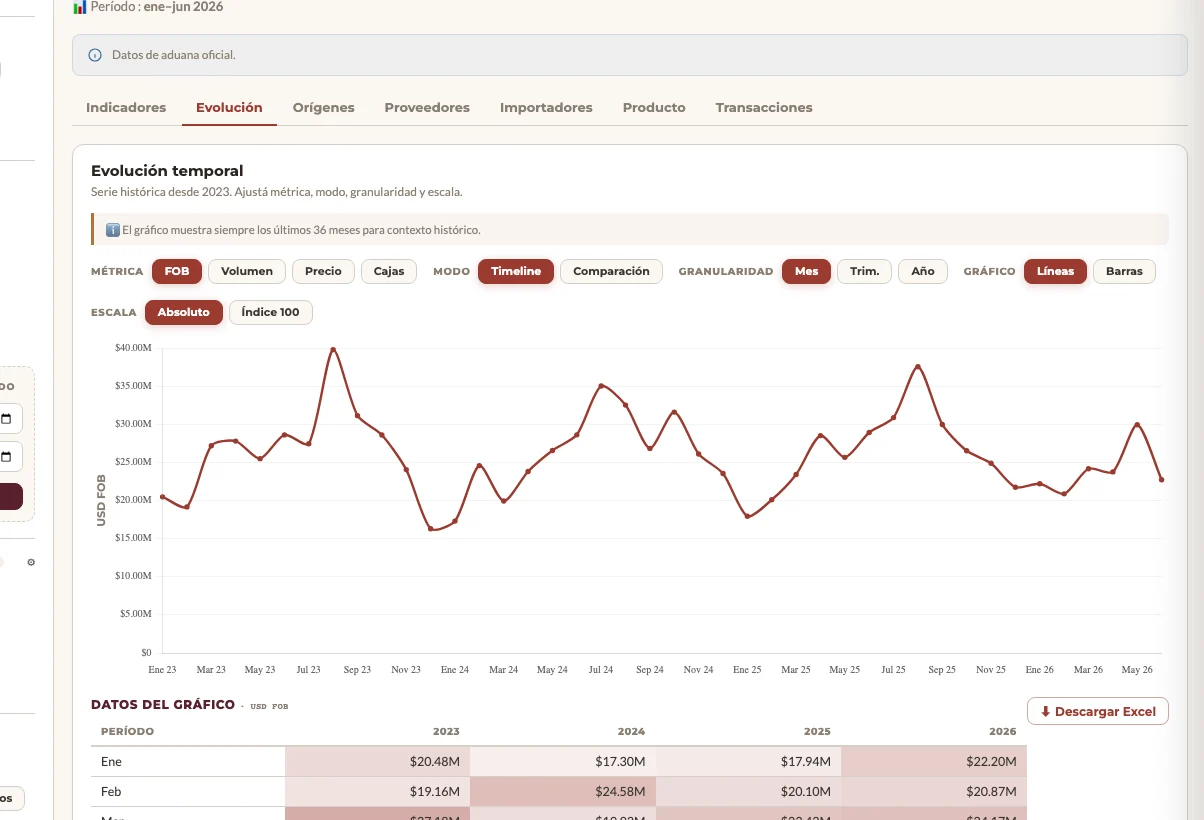
  • YoY moves and market share shifts in real time
  • Heatmap of prices by supplier and year, alerts on changes
Analyze my market
📊

Consultants and agencies

Verifiable customs data, unlimited exports, 100% wine specialization. Back your client reports with citable figures.

  • Official customs data from 18 markets, source of every figure documented
  • 16,000+ company profiles (importers + exporters)
  • Unlimited Excel exports, pivots, and multi-market comparisons
  • Baco AI assistant for custom analysis in seconds
Try for my clients
Our products

Wine customs data, sector experts

VinaTrade for detailed customs declarations. VinaLink for the importer and exporter map. Baco (beta) for AI-powered analysis.

Customs data

VinaTrade

Detailed customs declarations. Extracted by wine experts.

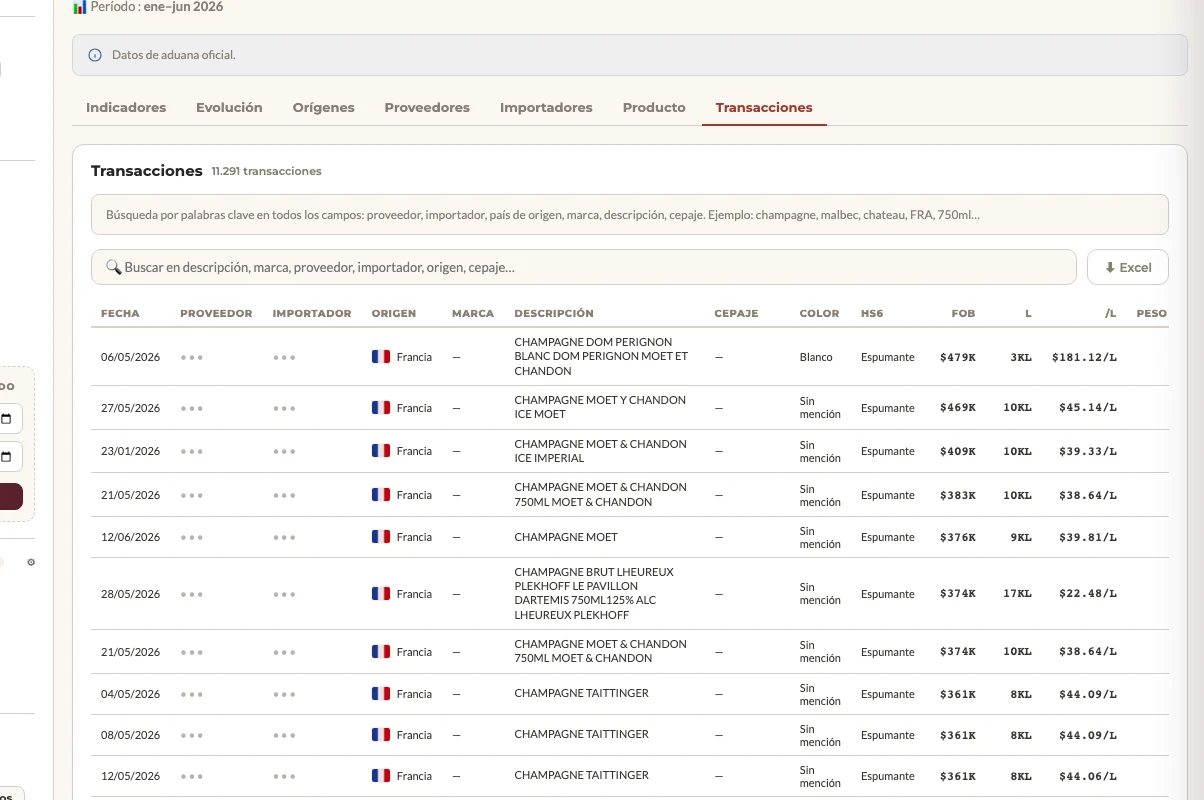
Each customs transaction enriched with the information that matters for the wine business: brand, grape, format, unit price, identified importer. 18 markets, 1.5M+ accumulated transactions.

18
Detailed markets
20 K+
Detailed brands
1.5 M+
Transactions
  • 16 import markets: USA, Brazil, Mexico, Russia, Peru, Vietnam, India, Colombia, Costa Rica, Ecuador, Panama, Kenya, Ivory Coast, Cameroon, Nigeria, Bolivia
  • 2 detailed export markets: Argentina (1,200+ wineries) and Chile
  • Brand by brand: unit price, volume, identified buyer
  • Unlimited Excel export, pivots, cross-market comparisons
Explore VinaTrade
AI Assistant Beta

Baco Beta

Your data analyst. On demand.

Ask a question in English, Spanish, or French — get a custom dashboard in 10 seconds. Save, share, refine: a collaborative analysis library. Currently in open beta.

Questions
~10s
Per dashboard
Anthropic
Frontier AI
  • Natural language questions, no SQL needed
  • Collaborative library: share analysis with your team
  • Edit block by block, refresh in one click
  • Multi-tab Excel export, standalone HTML
Try Baco (beta)
Powered by Anthropic
Trusted by

Wineries and traders worldwide

Plans & access

Four tiers, matched to your ambition

From free Discovery to full access across the 18 detailed markets. Pricing tailored to your region — get in touch for details.

Discovery
Free
No card, no commitment
  • Public macro reports (Brazil, USA)
  • Demo access to country profiles
  • 3 one-shot Baco questions
Starter
  • 1 import market + USA included
  • 16,000+ company directory
  • 30 Baco queries / month
  • 2 users
Enterprise
  • 16 import markets (all detailed)
  • Argentina + Chile detailed exports
  • 300 Baco queries / month
  • Team Baco library
  • 10 users
Frequently asked questions

Wine customs data: everything you need to know

What are the sources of your wine customs data?
Vinalitica works directly with official customs declarations from 18 markets: 16 import markets (USA, Brazil, Mexico, Russia, Peru, Vietnam, India, Costa Rica, Ecuador, Panama, Colombia, Kenya, Ivory Coast, Cameroon, Nigeria, Bolivia) and 2 detailed export markets (Argentina, Chile). Every transaction is traceable back to its source declaration: brand, price, volume, identified buyer and importer. As a complement, we aggregate UN Comtrade and OIV for the global macro view, but the core of Vinalitica is detailed customs declarations.
How often is customs data updated?
Customs declarations are refreshed monthly for the 18 covered markets, with a typical delay of 30 to 45 days after month-end depending on each country's customs authority. Every month we add new transactions to the 1.5M+ already accumulated.
How do I find wine importers in a specific market?
The VinaLink module maps 5,800+ wine importers across the 16 covered markets, filterable by purchase volume, wine style (sparkling, bottled, bulk, must), supplier origin and price range. Each importer has a profile with actual suppliers, volumes purchased year over year and prices paid. With premium plans, access to direct buyer contacts (verified LinkedIn + email). It's the fastest way to identify qualified prospects.
And for exporters? Do you show their customers?
Yes. For each of the 10,300+ exporters and suppliers that appear in the customs we cover, we show their actual customer book: the list of importers buying from them, volumes year by year, unit prices paid. Valuable information both for a winery wanting to benchmark a competitor and for an importer wanting to verify a new supplier's references.
What exactly does your 18-market coverage include?
16 detailed import markets with brand-by-brand customs declarations: USA, Brazil, Mexico, Russia, Peru, Vietnam, India, Costa Rica, Ecuador, Panama, Colombia, Kenya, Ivory Coast, Cameroon, Nigeria, Bolivia. 2 detailed export markets: Argentina (1,200+ wineries, brand by brand, price per litre, identified importer) and Chile (same). In total: 20,000+ brands detailed in transactions, 1.5M+ accumulated transactions, 16,000+ companies mapped with their real flows.
How is Vinalitica different from ITC TradeMap, Panjiva or Wine Intelligence?
Panjiva is generalist (all industries) and mostly US-focused. ITC TradeMap only shows country-level aggregates, without brand, price or buyer. Wine Intelligence publishes after-the-fact market studies. Vinalitica is 100% wine-specialized: we extract from each customs declaration the information that actually matters for the wine business — brand, grape, variety, format (bottled, bulk, sparkling), unit price, identified importer and exporter. It's a sector enrichment and wine expertise process that no generalist tool produces.
Can I try Vinalitica for free before subscribing?
Yes. The Discovery plan is free without a credit card: open macro reports on Brazil and USA, demo access to country profiles, and 3 questions to the Baco AI assistant. Enough to evaluate data depth and quality before any commitment. Account creation takes under 2 minutes via email.
Is the customs data reliable and verifiable?
Yes. Every transaction comes directly from the official customs authorities of each country (DECEX in Brazil, USDA/USITC in USA, Aduana Argentina, Aduana de Chile, Federal Customs Service in Russia, etc.). We apply a quality control process to detect outliers and inconsistencies, but the fundamental values — brand, price, volume, buyer — are those published by the customs administration. Every figure is citable and traceable back to its source declaration.
What does the Enterprise (Acceso Total Latam) plan include?
Access to the 18 detailed markets (16 import + Argentina and Chile in export), the 16,000+ importer and exporter profiles with their real partners, 300 Baco queries/month with collaborative library, unlimited Excel bulk export, 10 users. Contact us for pricing tailored to your region (Acceso Total Latam offer available for Argentina and Chile).

Wine customs data: the core of Vinalitica

Every time a case of Argentinian Malbec clears Brazilian customs, a bottle of Champagne arrives in Lima, or a container of Spanish Tempranillo lands in New York, an official customs declaration is recorded: value, volume, HS code (Harmonized System), origin, destination, and — depending on the market — the brand, format, identified buyer and seller.

These declarations are grouped under the HS 2204 code (wine of fresh grapes), with subcategories: 2204.10 (sparkling wines), 2204.21 (bottled wines ≤ 2L), 2204.22 (wines 2L to 10L), 2204.29 (bulk wines > 10L), 2204.30 (musts). Each subcategory reveals a distinct market segment with its own unit pricing and dynamics.

Each customs authority has its own format, its own publication delays, its own standardization. Vinalitica centralizes these heterogeneous flows, enriches them with wine sector expertise (grape, format, packaging), and presents them via dashboards, maps, and usable APIs — something no generalist tool like Panjiva or ITC TradeMap can do.

Detailed customs coverage

Finding wine importers: the Vinalitica method

Traditionally, a wine exporter wanting to identify importers in a new market had three options: (1) hire a consultant for €15-30k, (2) work the international trade show circuit like ProWein or Vinexpo for years, (3) manually navigate generalist databases without sector information.

With VinaLink, the process accelerates dramatically:

An Argentinian winery preparing a Peruvian market campaign can thus obtain, in 30 minutes, a qualified shortlist of active premium importers, with brand-by-brand purchase history and key contacts — work that would take months via traditional methods.

Why specializing in wine makes the difference

Generalist tools like Panjiva or ImportYeti aggregate customs declarations across all industries without sector structuring. Result: an entry like "Cabernet" might be a wine, a coffee brand, or a ship's name. An entry "Red wine 2022" doesn't automatically link to the producing winery or the grape variety.

Vinalitica applies a sector enrichment layer: we reconcile commercial names with actual wineries, identify grape varieties (Malbec, Cabernet Sauvignon, Tempranillo, Chardonnay, etc.), distinguish formats (bottled, bulk, sparkling), validate unit prices against the plausible range for the segment. It's this wine expertise work that turns raw customs data into actionable commercial intelligence.

Sources: official customs authorities — DECEX Brazil, USDA/USITC, Federal Customs Service Russia, SUNAT Peru, SAT Mexico, Aduana Argentina, Aduana de Chile, and others. Macro complement: UN Comtrade and OIV (International Organisation of Vine and Wine).


Try Vinalitica for free.

10 free queries per profile. No credit card, no commitment. Access takes under 2 minutes via email.