Argentine wine: what a higher price really buys on Vivino
The pricier an Argentine wine on the shelf, the better it scores on Vivino, but every extra tenth of a point costs more than the last: 2,900 pesos between 3.5 and 4.0, 17,500 between 4.0 and 4.5. And at the same price, the winery behind the bottle counts for far more than the grape.
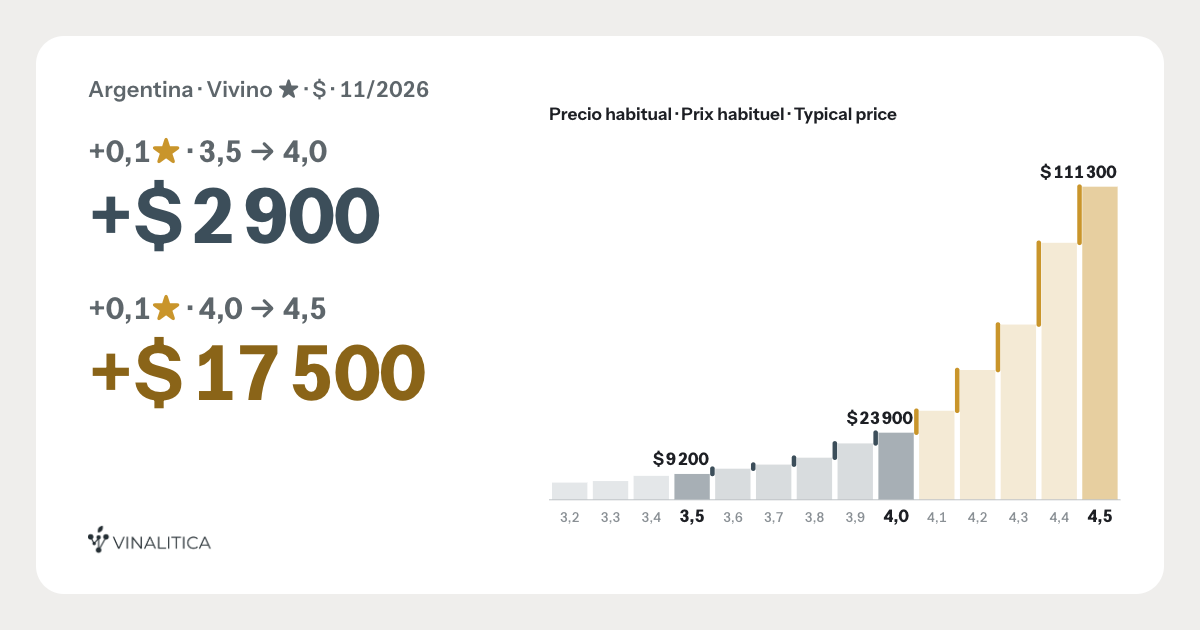
Plot the price of Argentine wines against their Vivino ratings and you get a staircase that grows steeper as it climbs. At the bottom, a few thousand pesos buy an extra tenth of a point; near the top it takes almost six times as much, until the steps flatten into a plateau where paying double barely moves the score. Somewhere along that staircase sits the question a winery actually cares about: is its wine well rated for what it costs? And when two wines cost the same, what sets them apart is neither the grape nor the region, but the house that made them.
To measure that relationship, Vinalitica matched the Vivino rating of 2,250 dry still wines from Argentina (reds, whites and rosés) from 194 wineries, each rated by at least 50 users, to its shelf price in Argentina in November 2026, drawn from the demonstration sample of its Retail module. Prices are shown in pesos and in US dollars at the official rate of 26 November (1,625 pesos to the dollar). Key figures come with their margin of error; the methodology is set out at the end.
Each extra tenth of a point costs 2,900 pesos between 3.5 and 4.0, and 17,500 between 4.0 and 4.5
Line the wines up by rating and look at the typical shelf price at each step, that of the wine in the middle: half cost less, half cost more. A wine rated 3.5 sells for around 9,200 pesos (US$5.6). At 4.0 you are looking at around 23,900 pesos (US$15); at 4.5, around 111,300 pesos (US$68). In the chart, each step of the staircase shows how much more you have to pay to gain a tenth of a point.
Between 3.5 and 4.0, each tenth of a point costs on average 2,900 pesos more (US$1.8). Between 4.0 and 4.5, each tenth costs on average 17,500 pesos more (US$11), which means moving into a different price bracket. The first figure is robust (margin of error: 2,400 to 3,600 pesos). The second is less precise, because few wines reach 4.5 (35, from 20 wineries): it lies somewhere between 11,700 and 29,500 pesos.
Price explains the score, up to a plateau
Overall the link is strong: ranking the wines by price or by rating gives almost the same order (a rank correlation of 0.84). On average, doubling the price adds 0.2 points (margin of error: 0.19 to 0.22). But the gain shrinks on the way up: 0.24 points below 12,000 pesos, 0.23 up to 30,000, 0.20 up to 80,000 and just 0.09 beyond. The differences between the first three zones sit within the margin of error; the drop above 80,000 pesos is clear-cut.
Between 64,000 and 128,000 pesos, roughly US$40 to US$80, the median rating stays at 4.3. At that level the gap between two wines has less to do with price than with style, vintage, the winery's reputation and what buyers expect from it.
A 4.0 is rare below 12,000 pesos and the norm above 30,000
From what price can you expect to find a wine rated 4.0? Below 12,000 pesos (US$7.4) it is a rarity: 2% of wines or fewer. Between 18,000 and 30,000 pesos, almost one in two. Above 60,000, nearly all of them. Higher up, the dividing line is 4.2: 40% of wines between 30,000 and 60,000 pesos reach it, and 78% between 60,000 and 120,000.
The 4.0s in the lower bands are precisely the wines that beat their price. And they turn up at every price point: in each band, 15% to 23% of wines score at least 0.15 points above what their price would suggest (18% overall). The share is a little higher in the cheapest band (23% below 8,000 pesos), but so is the share of wines rated well below their price (25%): ratings simply spread further at the bottom of the shelf. Value is not a price band, it is a particular wine, and the only way to spot it is to compare it with wines at the same price.
At the same price, grape and colour are worth a few hundredths of a point
Grape variety matters, though far less than price. At the same price, Petit Verdot scores 0.08 points above what its price would suggest and Cabernet Franc 0.06. Malbec, the country's signature grape, sits just above the line (+0.03), as do red blends. Merlot falls slightly short (−0.06), and so, among the whites, does Chardonnay (−0.04). For Torrontés, Sauvignon Blanc, white blends, Cabernet Sauvignon, Pinot Noir, Syrah, Bonarda and Malbec rosé, the gap is within the margin of error.
Colour matters even less. At the same price, a white scores 0.03 points below a red (margin of error: 0.01 to 0.05) and a rosé 0.04 below, a gap within the margin. A white rated 4.0 costs around 23,200 pesos and a red 23,900, and the slope is the same for all three colours: +0.2 points each time the price doubles. If whites carry a lower median rating than reds (3.8 against 3.9), it is mostly because they cost less: 15,500 pesos at the median, against 19,600.
These gaps are small next to the spread: at the same price, the middle half of Malbecs covers 0.2 points, four times the distance between Petit Verdot and Malbec. They are also fragile: leave out the wines rated on a single vintage (see the methodology) and Petit Verdot drops below the threshold, while Malbec's edge and the gap between whites and reds fall within the margin of error; Cabernet Franc keeps its lead. By province, the sample does not support any conclusion: outside Mendoza (1,848 wines from 170 wineries), each province rests on 4 to 18 wineries, and in three of them a single winery supplies close to half the wines.
At the same price, the winery counts for far more than the grape
Price accounts for about seven in ten of the differences in rating (69%). For the rest, we looked for what sets apart the wines rated above their price. By far the strongest factor is the winery: knowing how a house's other wines fare predicts a quarter of the gap for each of its wines (24%, with a margin of error of 18% to 29%). The grape predicts 3%. Region, province and colour predict nothing measurable.
What do the wineries that beat their price have in common? Partly, how well known they are. Notoriety, measured by the number of Vivino ratings per label (the total across all their wines divided by the number of wines), clearly separates the two ends: wines from the most-followed houses, with more than 2,000 ratings per label, score 0.08 points above what their price would suggest; those from the least-followed, under 700, score 0.04 below. But notoriety accounts for only a small part of the differences between wineries (16%): the rest comes down to what each house does, its vineyards, its style, its history, which the numbers cannot name. Neither the popularity of the wine itself, nor the age of the label, nor the winery's price range, nor the number of retailers stocking it adds anything once notoriety is taken into account.
Catena Zapata's DV Catena range is the clearest example. All 17 of its wines in the sample sit on or above what their price would suggest, by 0.33 points at the median: DV Catena Cabernet-Malbec, at 19,900 pesos, is rated 4.3 where its price would suggest 3.9. The house's other wines beat their price too (+0.14), and Catena Zapata is among the most-followed wineries on Vivino (around 9,200 ratings per label). A Vivino rating measures the wine, but also what its name promises: wineries are well known because their wines please, and their wines may also please because the wineries are well known. The numbers cannot pull the two apart.
One unknown remains: who does the rating. Vivino does not say which country its ratings come from. A widely exported wine may be rated largely outside Argentina, by buyers who paid a different price for it: the rating is global, while the price in this study is Argentine. That is one possible reading of the lead held by the best-known houses, not a finding: the data in this study cannot measure it.
For a winery, the useful question: is my wine well rated for its price?
A score on its own says little. A wine rated 4.0 at 18,000 pesos has a strong case: at that price, the expected rating is 3.85. The same 4.0 at 40,000 pesos falls short of what its price suggests (4.1). And a wine priced above the staircase has to make its case on something other than the score: style, history, scarcity, the name on the label.
That is what Vinalitica's Retail module shows: the shelf price of every wine, retailer by retailer, set against wines of the same grape, the same rating and the same price range, across whatever scope each client chooses.
Methodology
Sample. 2,250 dry still wines from Argentina, from 194 wineries (1,712 reds, 454 whites and 84 rosés), each rated on Vivino by at least 50 users (a median of 614 ratings per wine) and recorded on the shelf in Argentina in November 2026. Sparkling, sweet, fortified and orange wines (89 wines) are left out. The rating is each wine's Vivino average across all vintages; for 645 wines already in Vinalitica's database, it is the rating of the most-rated vintage. Without those 645 wines the conclusions hold: +0.21 points each time the price doubles, 2,800 pesos per tenth from 3.5 to 4.0 and 16,000 from 4.0 to 4.5, and the winery still predicts more than a fifth of the same-price gap (22%).
Prices. Each wine's price is its typical shelf price in Argentina in November 2026 for a 75cl bottle sold singly (excluding cases and multipacks): first the median of the prices recorded at each retailer, then the median across retailers, from the demonstration sample of Vinalitica's Retail module; each client chooses its own reference scope. The 'typical price' for a rating is the median of those prices among wines with that rating; the cost of a tenth of a point is the gap between the typical prices at 3.5 and 4.0 (or 4.0 and 4.5), divided by five. US dollars at the official rate of 26 November 2026 (1,625 pesos).
Matching. Each Vivino wine is matched to a Vinalitica wine record by name, winery, grape and range (Reserva, Gran Reserva, Roble…). A hand-checked sample shows fewer than 2% doubtful matches.
Expected rating. The rating a wine's price would lead you to expect follows the curve in the second chart: one straight line per price zone (under 12,000, 12,000 to 30,000, 30,000 to 80,000, over 80,000 pesos), joined end to end. A single line across all prices would have skewed the reading: because ratings level off at the top, it would have placed too many mid-priced wines above their price and too many expensive ones below it.
Margins of error and thresholds. Wines from the same winery tend to resemble one another, so they do not count as independent observations. Each figure was therefore recalculated 2,000 times on wineries drawn at random; the margin of error covers 95% of those draws. A rating, column or band is shown only if it holds at least 30 wines; a grape or a province needs at least 30 wines from 20 wineries, with no single winery supplying more than a quarter of them. Each grape is counted with its colour: Malbec rosé is analysed apart from red Malbec. That is why ratings below 3.2 or above 4.5, prices outside 4,000 to 128,000 pesos on the map, and every province except Mendoza are left out of the charts.
What explains the gap. The share of the same-price gap that a factor predicts is measured out of sample: each wine's gap is predicted from that of the other wines in its group (the winery's other wines, or wines of the same grape, region, province or colour from other wineries), pulled towards zero when the group is small; the share is how much that prediction reduces the error compared with predicting no gap at all. Region: as recorded by Vivino (Uco Valley, Luján de Cuyo, Cafayate…). Notoriety: total Vivino ratings across all of a winery's wines, divided by its number of wines on Vivino. Margins of error: 1,000 draws of wineries.
Limits. Vivino reflects its users: they are not a representative panel of Argentine consumers, and an expensive wine is mostly rated by the people who bought it. Vivino does not publish where its raters live: an exported wine may be rated largely abroad, at a different price. The study measures links between price, winery and rating, not causes.
Update, 26 November 2026. The analysis now covers all dry still wines (2,250 wines: reds, whites and rosés) rather than reds alone. We added a paragraph on colour, a section on what explains the same-price gap and the chart on 4.0 ratings, and recalculated prices without the cases and multipacks that had slipped into the price records. The figures move little: a tenth of a point from 3.5 to 4.0 goes from 3,100 to 2,900 pesos, and from 4.0 to 4.5 from 18,900 to 17,500; the conclusions are unchanged.
See also: Monthly report on Argentine wine exports · Exporting wineries and brands
← Back to the blog