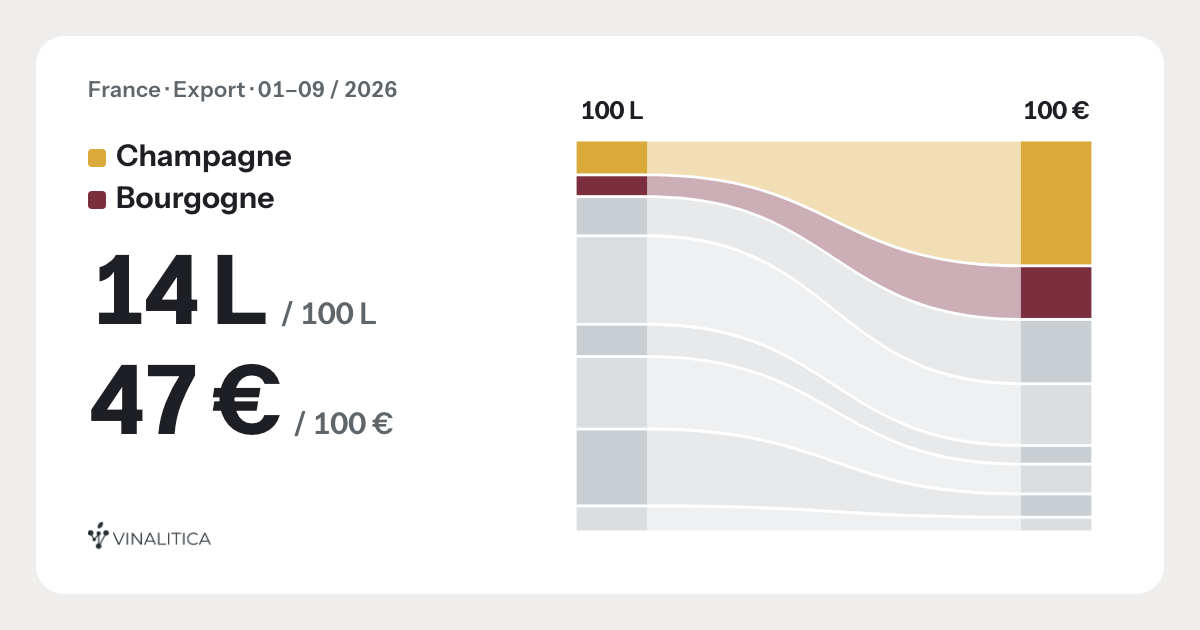
French wine exports in 2026: Champagne and Burgundy take 47% of the value from 14% of the volume
France exported €8.25bn of wine between January and September 2026, up 0.7% on a year earlier. The flat headline hides a trade ever more concentrated in Champagne and Burgundy, big markets taking more wine at lower prices, and a sharp swing in shipments to the US either side of the tariffs. Six charts built from French customs data.
France exported €8.25bn of wine in the first nine months of 2026, 0.7% more than in the same period of 2025, according to French customs (DGDDI) data processed by Vinalitica. Volumes rose by the same margin to 949 million litres, leaving the average price unchanged at €8.70 a litre.
That steady total says very little about the year. The six charts below show where the value comes from, how each wine has moved since 2021, which markets are taking more volume and which are paying more per litre, how the US tariffs show up month by month, and what France buys in return.
Champagne and Burgundy: 14% of the volume, 47% of the value
Of every 100 litres of wine France exports, nine are Champagne and five are Burgundy. Of every €100, Champagne brings in €33 and Burgundy €14. Between them, the two regions account for 47% of export value from 14% of the volume.
At the other end of the scale, IGP wines and wines without a geographical indication make up 39% of the volume but only 13% of the value. Bordeaux sits in between, with 10% of the volume and 17% of the value. And the gap is widening: in 2021, Champagne and Burgundy accounted for 41% of the value from 13% of the volume.
Since 2021, France has been shipping less wine at higher prices
Over the first nine months, France exported 13% less wine by volume than in 2021 (949 million litres against 1,088 million), while the average litre was worth 18% more (€8.70 against €7.38). The chart follows each category year by year: a move to the left means lost volume, a move upwards a higher price per litre.
Bordeaux has lost a third of its volume (93 million litres, down from 138 million) while its price per litre rose 16%; Languedoc-Roussillon appellations have lost half of theirs. Burgundy and the Loire have gained mostly on price (+35% and +34%). Champagne is shipping almost as much as in 2021, at prices 19% higher. Crémant is the only category to grow volume significantly, up 57% at a near-unchanged €5.81 a litre.
The big markets are taking more wine, at lower prices
Between 2025 and 2026, the top 20 destinations split into two groups. The US (volume +9.4%, price per litre −6.8%), the UK, Germany and Singapore are taking more wine at lower prices. Italy, China, Spain and South Korea are taking less, but paying more for each litre.
The UK, France’s second-largest market, follows the US pattern on a smaller scale: volume up 8.9%, price per litre down 3.1% and value up 5.6% to €1,083m. Champagne shipments to the UK rose 8% in value; Bordeaux fell 7%. Italy is the clearest case on the other side: 12% less volume at prices 30% higher, lifting value by 14%, with Champagne making up two-thirds of it. Germany took 5% more wine at prices 12.5% lower, with more of it in bulk: 47 million litres against 36 million, at €0.56 a litre against €0.88.
A litre of French wine: under €4 in Germany, over €45 in Hong Kong
The average price per litre shows what kind of French wine each market buys. It stays below €5 in Germany and the Netherlands; in Germany, one litre in three is shipped in bulk. It tops €35 in Singapore, where Champagne accounts for 71% of the volume, and in Hong Kong, where Bordeaux makes up almost half the value.
Since 2021, China has been the starkest case: it takes less than a third of the volume it did then (20 million litres against 71 million) and pays twice as much per litre (€11.73 against €5.64). In Japan and Italy, the price per litre has risen by more than a third. In the UK it has barely moved, up 5% to €8.96, and the increase in Germany (+9%) and Belgium (+10%) is similarly modest.
US: shipments spiked ahead of the tariffs, then fell below normal
The chart tracks export value month by month against the usual range for that month, from the lowest to the highest level of 2021–2023 (grey band), which strips out seasonality. Shipments to the US break out of the band twice. First on the upside, just before the US tariffs took effect: four of the five months from November 2024 to March 2025 were above it, with €322m in December 2024, twice a normal December. Then on the downside: since April 2025, 14 of 18 months have fallen below it, with August 2025 down 44% and September down 45% on the 2021–2023 average for the same month, as the 15% rate on EU wine came into force.
In 2026 the gap has narrowed but not closed: from July to September, shipments to the US were still 9% to 20% below their usual level, higher than in 2025 but lower than in 2024. Over nine months, the US remains the largest market for French wine at €1,528m (+2.1%), but 8.8% below 2024. Shipments to all other destinations have stayed close to their band: since 2024, no month has strayed more than 17% from its usual level.
France exports bottles and imports bulk
Going the other way, France imported 347 million litres of wine between January and September 2026, worth €618m (−8.5%). The two flows look nothing alike: of every 100 litres exported, 68 leave in bottle and 17 are sparkling; of every 100 litres imported, 68 arrive in bulk, at €0.65 a litre. France’s surplus on its wine trade reached €7,635m in nine months.
At the bottom of the market, the two sides mirror each other. France ships 47 million litres of bulk wine to Germany at €0.56 a litre and buys 178 million litres of bulk from Spain at €0.52. Sparkling wine moves both ways too: 39 million litres of crémant went out, 26 million litres of Prosecco came in. Prosecco is now the largest single item in France’s wine imports, worth €92m, three times its 2021 level.
What the charts mean for a wine business
A 0.7% average describes no producer’s year. Bordeaux exported to Switzerland lost 13% in volume and 27% in value; Champagne shipped to Singapore gained 27% in volume. And an exporter growing volume in a big market needs to watch its price per litre, which is falling there: −6.8% in the US, −12.5% in Germany.
Vinalitica updates this customs data every month, by category, destination country and French département, and links it to the imports declared in destination markets. The France study lets you rebuild these charts for any category or market.
Methodology. Source: French customs (DGDDI), foreign trade statistics, chapter 2204 of the Combined Nomenclature (wine of fresh grapes and grape must), November 2026 release, data to September 2026. Exports: values in euros declared on export (FOB), by country of destination. Imports: CIF values, by country of origin; the total includes €49m of undetermined origin and €24m of French-origin wine re-imported. Volumes in litres; the average price per litre is value divided by declared litres. Comparisons cover the same months (January to September). 2026 figures are provisional and revised monthly by customs. Categories group the eight-digit customs codes: ‘other appellations’ covers the Rhône Valley, the Loire Valley, Alsace, Beaujolais, Languedoc-Roussillon appellations and the EU-wide codes that hold most other French appellations (Provence, South West…); ‘crémant’ means appellation sparkling wines other than Champagne, ‘sparkling, no AOP’ sparkling wines without an appellation; ‘other’ covers foreign wine re-exported from France (€207m), wines over 15% abv and grape must. Spirits, including Cognac and Armagnac, are excluded. The country shown is the declared destination or origin, which is not always the country of consumption or production.
See also: Monthly report on Argentine wine exports · Exporting wineries and brands
← Back to the blog