Latin America buys a different France: 36% of the French wine it imports is sparkling
Sparkling wine makes up 12% of French production but 36% of the French wine exported to Latin America: Champagne and, above all, sparkling wine without an appellation. Crémant, the Rhône, the Loire, Languedoc and Alsace are all but absent. And every region of the world has its own way of buying French wine.
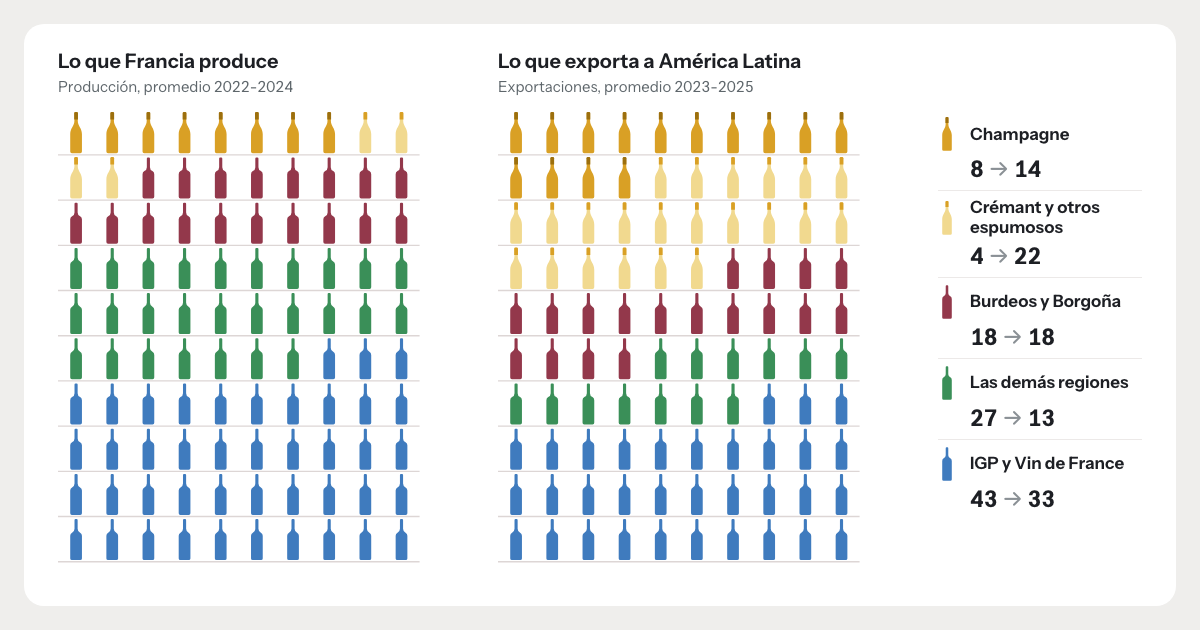
Of every 100 litres of wine produced in France, 12 are sparkling: 8 of Champagne and 4 of crémant or other appellation sparkling wines, such as Clairette de Die or Blanquette de Limoux. Of every 100 litres exported to Latin America and the Caribbean, 36 are sparkling: 14 of Champagne, 20 of sparkling wine without an appellation and just over one of crémant. Conversely, the Rhône, the Loire, Languedoc-Roussillon and Alsace make up 17.5% of production but only 6.2% of export volume to the region, against 18.4% of exports to the United States and Canada.
Latin America does not buy a representative sample of what France produces. It buys a selection: bubbles, Bordeaux and Burgundy. Other regions of the world also depart from the production profile, but Latin America is among those that depart from it most.
To measure this, Vinalitica cross-checked two official French customs series: harvest declarations (2022-2024 average) and exports (2023-2025 annual average). France produces an average of 31.7 million hectolitres of wine a year, with or without a geographical indication, excluding wine for distillation; sparkling wines are counted from the declarations by appellation. Each year it exports 18.4 million litres to the 44 destinations in Latin America and the Caribbean, 1.5% of its wine exports by volume, worth 200.1 million euros (1.8% by value).
Champagne: almost double its share of production, and half the value
Champagne accounts for 7.9% of French production (2.51 million hectolitres a year of base wine for Champagne, reserve included) and 9.6% of exports by volume. In exports to Latin America its share rises to 14.3%. By value it is half: 101.0 million euros a year, or 50.5% of the value exported to the region, against 35.0% for French exports as a whole. Champagne exported to Latin America is also dearer, declared at 38.2 euros a litre against 33.8 on average across all destinations.
Crémant, by contrast, barely gets there. Sparkling wines with an appellation other than Champagne make up 3.9% of production and 3.5% of exports by volume, but only 1.4% of export volume to Latin America. They include crémant from Alsace, the Loire, Burgundy and Bordeaux, as well as Saumur, Vouvray, Clairette de Die, Blanquette de Limoux and others.
By volume, the bubbles exported to Latin America are mostly sparkling wine with neither an appellation nor a geographical indication, declared at 3.1 euros a litre: 20.1% of the volume, against 4.2% for French exports as a whole. The region takes 7.3% of France's exports of these sparkling wines, although it accounts for only 1.5% of its wine exports. Colombia (0.76 million litres a year) and Brazil (0.74) are their leading destinations. Harvest declarations cannot isolate them: they are made from wines without a geographical indication and declared as such.
Bordeaux and Burgundy hold their share by volume, but not by value
Bordeaux accounts for 11.5% of production and 11.8% of export volume to Latin America. Burgundy and Beaujolais account for 6.1% of both. By volume, the region buys these wines almost in the proportions in which France produces them.
By value, they weigh less than in French exports as a whole. Bordeaux accounts for 11.6% of the value exported to Latin America, against 19.0% across all destinations; Burgundy and Beaujolais for 10.3%, against 14.5%. Bordeaux exported to the region is declared at 10.7 euros a litre, against an average of 14.4; Burgundy at 18.3, against 21.5.
The Rhône, the Loire, Languedoc and Alsace barely reach Latin America
Excluding their sparkling wines, the Rhône Valley (7.1% of production), the Loire (5.5%), Languedoc-Roussillon (3.0%) and Alsace (1.8%) together account for 17.5% of French production. For the Rhône and Languedoc, only reds and rosés are counted, and for Alsace only whites: these are the only colours French customs codes single out for exports. The four regions make up 11.8% of exports by volume, but only 6.2% of export volume to Latin America, where Alsace does not exceed 0.3%. Distance is not the reason: in exports to the United States and Canada, these regions account for 18.4%, slightly more than their share of production.
Everyday wine also weighs less. IGP wines, including Pays d'Oc, and Vin de France without a geographical indication make up 43.5% of production and 45.3% of exports by volume, but 33.5% of export volume to Latin America and only 10.4% of the value. Over half of IGP production (53%) comes from Languedoc-Roussillon.
In these segments, France is up against nearer suppliers. In the Latin American customs data tracked by Vinalitica, Chile was the top country of origin in 2025 for wine imported by Colombia (38% of the value), Ecuador (30%) and Costa Rica (23%). Spain led in Mexico (32%) and Panama (26%), and Argentina in Peru (35%) and Uruguay (64%). France ranked fourth in Mexico, third in Uruguay and fifth in the other markets.
Brazil and Mexico buy two different Frances
Brazil, the leading Latin American destination by volume (6.2 million litres a year), buys everyday wine in the same proportion as France produces it: IGP and Vin de France make up 43.4% of its volume. Bordeaux and Burgundy account for 26.6% and bubbles for 21.3%. The other regional appellations (Rhône, Loire, Languedoc, Alsace, Provence, South-West…) account for only 8.6%, against 26.8% of production.
Mexico (3.3 million litres a year) sits at the other extreme: Champagne makes up 26.4% of its volume and bubbles as a whole 34.5%, while IGP and Vin de France account for 24.8%. Both countries stand almost as far from the production profile as the region as a whole, for opposite reasons.
Every region buys its own France; Latin America's is among the furthest from French production
To compare destinations, Vinalitica calculated the gap between the profile of their purchases and that of French production. It is 0% when exports to a region exactly reflect the production profile, and it rises as they move away from it. Sparkling wines without an appellation are counted with Vin de France, as harvest declarations do not separate them.
The purchases closest to the production profile are in Switzerland (10%), Belgium (13%) and Canada (18%). French exports as a whole come out at 20%. At 35%, Latin America is further away than the United Kingdom (24%), the United States (28%) and the Middle East (29%). Only Asia, Africa and Russia are further still.
Each region departs from it in its own way. Germany and the Netherlands mostly buy everyday wine: IGP and Vin de France make up 68% and 74% of their volume respectively. China and Japan focus on Bordeaux and Burgundy (48% and 38%), Singapore on bubbles (71% of its volume). As in South-East Asia and Oceania, sparkling wine makes up more than 30% of export volume to Latin America.
Rhône, Languedoc and Loire houses already have importers in the region
These under-represented regions already have customers in Latin America. Vinalitica tracks import customs data for Mexico, Colombia, Peru, Ecuador, Costa Rica, Panama and Uruguay (latest twelve months available), Brazil (2024) and Bolivia (twelve months to April 2024). Over these periods, 71 importers in 8 markets bought from at least one of the 42 Rhône Valley houses present in the region. For Languedoc-Roussillon, it is 58 importers and 33 houses; for the Loire, 47 importers and 50 houses. Bordeaux houses supplied 126 importers, and Burgundy and Beaujolais houses 116.
These figures count importers by the house that supplies them, across all its wines, and assign each house to a region by its address. A Rhône house may also ship wines from other regions, and a négociant sometimes exports wines from outside the region of its head office.
Bubbles and Bordeaux join an existing flow; the Rhône and the Loire face Chile, Spain and Argentina
For a French house, the question is not whether Latin America buys French wine, but which France it buys. A Champagne, sparkling wine or Bordeaux house joins a flow that already exists. A Rhône or Loire house finds few French houses from its region already in the market, and faces competition from Chile, Spain or Argentina in everyday wine.
Some have already paved the way. Over the last twelve months, M. Chapoutier, in the Rhône Valley, supplied nine importers in five markets (Brazil, Costa Rica, Ecuador, Mexico and Panama). In Vinalitica, each house's export profile shows its importers in every market, so it can measure its position against other houses from its region.
Method. Sources: harvest declarations filed with French customs (average of the 2022, 2023 and 2024 harvests; appellation, IGP and non-GI wines, excluding wine for distillation) and exports recorded by French customs (2023-2025 annual average, in litres and euros), processed by Vinalitica. Wine categories are groupings of Combined Nomenclature codes. The gap with the production profile adds up, category by category, the differences in volume share between exports to a region and production, then divides the total by two: 0% for an identical profile, 100% for two profiles with nothing in common. In the production data, regional appellations are grouped by département (Bordeaux: Gironde; Burgundy and Beaujolais: Côte-d'Or, Saône-et-Loire, Yonne and Rhône; Rhône Valley: Vaucluse, Drôme, Ardèche, Gard and the Loire département; Languedoc-Roussillon: Aude, Hérault, Pyrénées-Orientales and Lozère; Alsace: Haut-Rhin, Bas-Rhin and Lorraine). As in the export customs codes, only reds and rosés are assigned to the Rhône Valley and Languedoc-Roussillon, and only whites to Alsace; their other colours are counted under other appellations, in both the production and the export data. Sparkling wines are taken from the declarations by appellation (Champagne, crémants, Clairette de Die, Blanquette de Limoux, sparkling Saumur, Vouvray and others, plus IGP and non-GI wines declared as sparkling) and removed from their region. For Champagne, the declaration by appellation (2.51 million hectolitres a year, reserve included) replaces the count by département (2.38 million). Sparkling wines made from wines without a geographical indication cannot be isolated in harvest declarations. France exports more Vin de France than it declares at harvest (declassifications, blends, stocks). Foreign wines re-exported by France are excluded. Latin America and the Caribbean: the 44 destinations with recorded exports, excluding Saint-Barthélemy, a French overseas collectivity. Without the Caribbean islands (4.5 of the 18.4 million litres exported each year), the results barely change: 35% sparkling, 5.9% for the four regions and a 35% gap with the production profile. The declared destination country is not always the final market. Importers: import customs data processed by Vinalitica; each house is assigned to a region by its address, and each importer is counted once per region, across all the house's wines.
See also: Monthly report on Argentine wine exports · Exporting wineries and brands
← Back to the blog