Pinot Noir on Vivino: a 4.0 comes at $32 from the US, $51 from France and $68 from New Zealand
Vinalitica matched the Vivino rating and price of 4,781 Pinot Noirs from 27 countries. On average a $40 wine scores 4.0, but origin shifts that line: California and Oregon rate above what their price predicts, while regional Burgundy, Marlborough and Germany fall short.
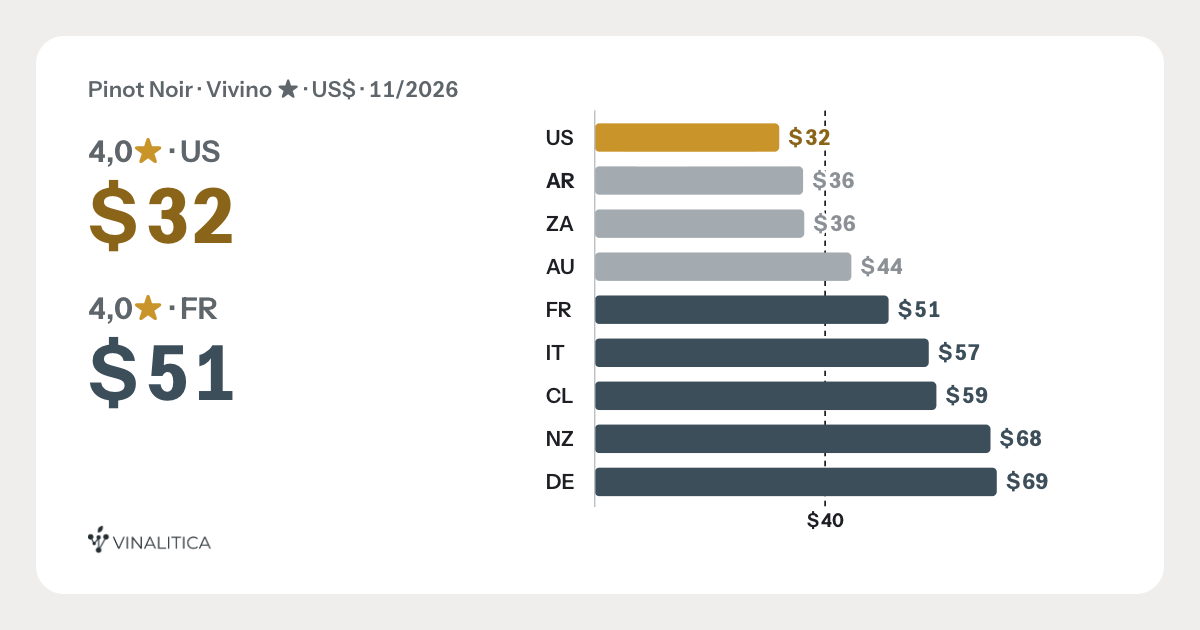
At $40, a Pinot Noir scores 4.0 on Vivino on average. Origin moves that line: an American Pinot gets there at $32, an Argentine one at around $36, a French one at $51 and a New Zealand or German one at about $68.
Those are the findings of an analysis by Vinalitica, carried out on 26 November 2026, of the rating and listed price of 4,781 Pinot Noirs from 2,074 producers in 27 countries, all offered by US retailers on Vivino and rated by at least 25 users.
After Argentine wine, we turned to the most international grape of all, claimed by Burgundy, California, Oregon, New Zealand and Patagonia alike. The method is unchanged: a curve gives the rating a wine can be expected to reach at its price, and the distance from that curve shows whether an origin rates better or worse than its price suggests.
All prices come from a single market, the US, so the comparison is between wines sold side by side.
A 4.0 arrives at around $40, and ratings barely climb after that
Price accounts for 60% of the differences in rating across the 4,781 wines, and ranking them by price or by rating produces almost the same order (a rank correlation of 0.76).
Not every dollar buys the same, though. Doubling the price from $10 to $20 lifts the expected rating by 0.25 points, and from $20 to $40 by 0.29; from $40 to $80 the gain falls to 0.13, and from $80 to $160 to 0.07.
The expected rating moves from 3.5 at $11 to 3.8 at $25, and reaches 4.0 at $40. The next tenth already takes $67, and a 4.2 close to $160.
The plateau is not unique to Pinot Noir: in our study of Argentine wine, doubling the price above 80,000 pesos (about $49) added just 0.09 points.
At the same price, US Pinot gains a tenth of a point; New Zealand and Germany lose one
To compare origins, we measure how far their wines sit, on average, from the rating expected at their price. US Pinot Noirs rate 0.09 points above it, French ones 0.05 below, and New Zealand and German ones 0.10 and 0.11 below.
In dollar terms, an American Pinot reaches 4.0 at $32, a French one at $51 and a New Zealand or German one at $68–69.
Argentina and South Africa come just behind the US, with a 4.0 at around $36. On 50 and 32 wines, their lead in points (+0.04) is within the margin of error, but the gap with France is clear: $31–44 for an Argentine 4.0, $47–54 for a French one.
Australia sits on the average; Italy and Chile slightly below it.
Between $40 and $100, the US lead over France holds steady, and Argentina stays close behind the US
Drawing one curve per country, across the price range where each sells most of its wines, shows how the gap moves with price. Between the US and France it barely shifts: 0.17 points at $40, 0.18 at $100.
At $40, an American Pinot Noir is expected to score 4.09, an Argentine one 4.07, a French one 3.92 and a New Zealand one 3.91.
The price ranges only partly overlap: half the Argentine Pinots in the sample sell for under $24, half the French ones for over $124.
Where they meet, Argentina sits 0.03 points below the US, within the margin of error, and 0.16 points above New Zealand at $30.
The Côte de Nuits holds its ground; regional Burgundy trails furthest
Breaking the figures down by area sharpens the picture. In California, Sonoma (+0.15) and Anderson Valley in Mendocino County (+0.13) clearly beat their expected rating, while Oregon and the Central Coast (Santa Barbara, Monterey) gain 0.08.
In Burgundy, the Côte de Nuits, whose wines sell at a typical $278, rates almost exactly as its price predicts (−0.02); the Côte de Beaune slightly less well (−0.05).
In Burgundy, the shortfall is concentrated at the base of the appellation pyramid. Regional Burgundies (Bourgogne, Hautes-Côtes, Côte d'Or…), at a typical $44, rate 0.14 points below their price, the widest gap in the study.
New Zealand shows the same contrast between Marlborough (−0.12, at $27) and Central Otago, on par with expectations for wines at $52.
In Argentina, Patagonia (+0.06) and Mendoza (+0.04) sit above the expected rating, but on 24 and 25 wines their lead is within the margin of error.
For Pinot Noir, origin matters as much as the producer
In Argentine wine, the producer predicted a quarter of a wine's distance from its expected rating, and the region almost nothing. For Pinot Noir worldwide, origin counts as much as the producer.
Other producers' wines from the same appellation predict 26% of that distance, the wider area 24% and the country alone 19%. The producer's own other wines predict 23%.
These shares do not add up: every producer belongs to an appellation, and what they tell us partly overlaps. They do show that between Sonoma and regional Burgundy, the vineyard address matters as much as the name on the label.
The country alone says less, because it groups very different areas, such as Marlborough and Central Otago.
With our shelf prices, the gaps narrow but the order holds
Vivino prices are those listed by US retailers. To cross-check them, we took the wines we also find in our shelf-price data (the demonstration sample of Vinalitica's Retail module), converted prices into dollars and removed each market's own effect.
The order of origins does not change: the US lead narrows to 0.03 points, France's shortfall to 0.02, and New Zealand moves back within the margin of error.
Part of the narrowing comes from the wines themselves: on Vivino, the US lead rests mostly on less-followed Pinot Noirs that we do not find on the shelf (+0.10, with a median of 428 ratings), while those we do find sit at +0.07.
Argentine Pinot Noir, by contrast, does better on our shelf prices: +0.07 points, a lead that this time lies outside the margin of error (+0.03 to +0.12).
At the same Vivino rating, several Argentine Pinot Noirs cost 30% to 80% less than renowned benchmarks
Several widely rated Argentine Pinot Noirs clearly beat the rating expected at their price. Each matches the score of renowned Pinots from elsewhere that sell for more in the same US market.
Domaine Nico's Grand Père, rated 4.2 at $35, scores level with Felton Road's Bannockburn from Central Otago ($65) and Domaine Trapet's Gevrey-Chambertin ($103).
At the top end, Bodega Chacra's Treinta y Dos from Patagonia is rated 4.4 at $154, the same as Château de la Tour's Clos Vougeot Grand Cru ($400) and the Clos des Lambrays Grand Cru ($697).
The same rating does not make two wines equivalent: it says Vivino users like them equally, across all vintages. Each benchmark cited is itself rated at or above the level its price predicts.
At $30, a Pinot Noir rated 4.1 beats Sonoma's average lead
For a producer, the rating alone says little: what matters is the rating against the price and the area. A $30 Pinot Noir is expected to score 3.88. Rated 4.1, it beats that by 0.22 points, more than Sonoma's average lead (+0.15).
Rated 3.8 at the same price, it sits 0.08 points below the curve, between the Côte de Beaune (−0.05) and Marlborough (−0.12).
Argentine Pinot Noirs, at a typical $24 in the US, compete in the band where ratings rise fastest with price: between $20 and $40, each doubling of the price is worth 0.29 points on the world average.
Methodology
Sample. 4,781 still red Pinot Noirs from 2,074 producers in 27 countries, offered by US retailers on Vivino (the platform only shows wines with an offer in the viewer's market) and rated by at least 25 users (a median of 509 ratings per wine). Data collected on 26 November 2026 through Vivino's search, grape Pinot Noir. Blends and other styles that Vivino also files under the grape (Passetoutgrain, Coteaux Bourguignons, Dôle…) are left out: 175 wines. The rating is each wine's Vivino average across all vintages.
Prices. Listed price in US dollars for a 75cl bottle: the median across the vintages on offer. Using only 2019 and later vintages, or working vintage by vintage (each vintage's own rating and price), the conclusions hold: a 4.0 at around $41 or $38, the US at +0.10 or +0.09, France at −0.05 or −0.04, New Zealand at −0.10 or −0.11 and Argentina at +0.05 or +0.06.
Expected rating. A curve of rating against the logarithm of price, made of straight segments joined at $20, $40, $80 and $160 and fitted on all wines. An origin's distance is the average, over its wines, of rating minus the rating expected at their price; the price of a 4.0 is where the curve, shifted by that distance, reaches 4.0. It is not the typical price of wines rated 4.0: those sell at a median $50, because at any price ratings spread around the curve.
Country curves. For each country, the overall curve is shifted and tilted (two parameters fitted on its wines), then drawn from the 10th to the 90th percentile of its prices. Between $40 and $100, the US–France gap ranges from 0.17 to 0.18 points, give or take 0.03 (95% margins).
Margins of error. Wines from the same producer are not independent: the 95% margins come from 2,000 resamples of producers, with replacement. A country or area is shown only if it has at least 30 wines and 20 producers, with no producer accounting for more than a quarter. The only exceptions are Patagonia (24 wines, 14 producers) and Mendoza (25 wines, 18 producers), shown for reference.
What predicts the distance. Each wine's distance is predicted from the average of the producer's other wines, or of wines from its appellation, area or country made by other producers, pulled towards zero when the group is small; the predicted share is the proportion of the variance of the distance explained in this way. Areas are groupings of appellations made by Vinalitica (Côte de Nuits, Sonoma, Oregon…); margins are about four points.
Cross-check with our shelf prices. Vivino's Pinot Noirs were matched to Vinalitica wine records by producer and wine name, within the same country (of 30 matches checked by hand, all 30 were right). Their price is the typical shelf price recorded since October 2026 for a 75cl bottle sold singly, from the demonstration sample of the Retail module; each client chooses its own reference scope. Prices converted into US dollars at the day's rate; the curve removes a gap specific to each market.
Examples. Argentine Pinot Noirs with at least 2,000 ratings, among those that most exceed the rating expected at their price, one per producer. Benchmarks: Pinot Noirs from other countries with the same rating (Vivino's average for the wine, all vintages), among the most rated and themselves rated at or above the level their price predicts. Vivino rounds ratings to one decimal place.
Limits. The sample only includes wines sold in the US with enough ratings: seven in ten reach 4.0. Vivino reflects its users and does not publish where its raters live: an American Pinot Noir may be rated mostly by Americans. The study measures links between price, origin and rating, not causes.
See also: Monthly report on Argentine wine exports · Exporting wineries and brands
← Back to the blog